CBSE affiliation is the Board's formal approval for an eligible school to follow its curriculum and, where approved, present students for CBSE examinations. This guide is for school owners, principals and management teams planning a new application, a change of board or an expansion to higher classes.
Latest CBSE Update — 30 September 2026
CBSE has extended the online application deadline for various affiliation categories for the 2027–28 session through SARAS 7.0 to 10 October 2026. Check the official CBSE circular archive and SARAS portal for the applicable notice and category-specific instructions. Verify the latest CBSE circular before applying. This deadline is time-sensitive and may not apply to every application category.
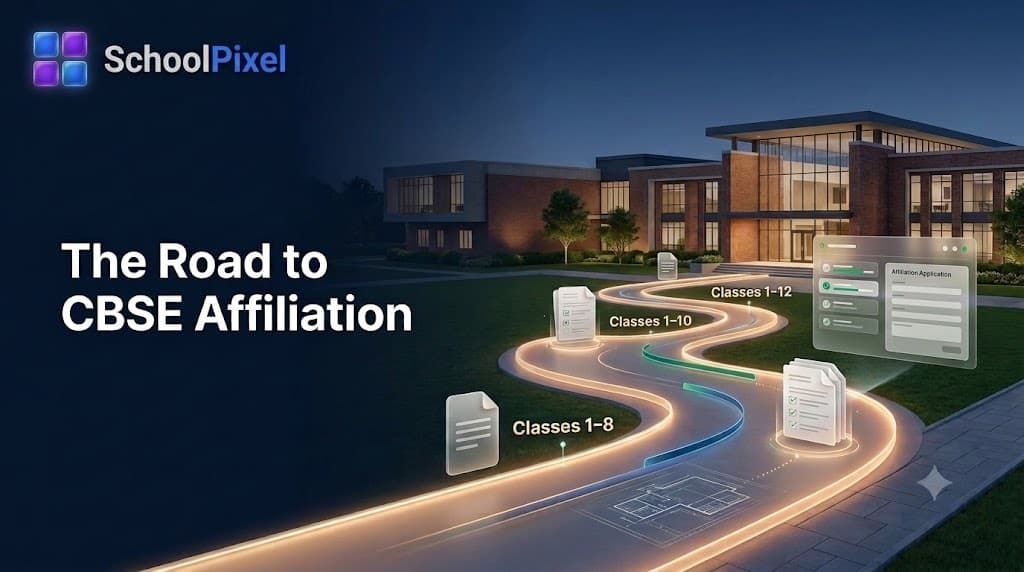
What Classes Can a School Get CBSE Affiliation For?
Middle Class Syllabus
Classes 1–8
The middle-level route for schools seeking approval for Classes 1 to 8.
Secondary Level
Classes 1–10
Affiliation through the secondary stage, up to Class 10.
Senior Secondary Level
Classes 1–12
Affiliation through the senior secondary stage, up to Class 12.
These labels describe the approved class range, not an automatic entitlement to open every class at once. The application category, permissions, school readiness and current CBSE rules determine the route and the approval granted. Confirm the category and class scope in the official affiliation information and SARAS before planning admissions.
What Is CBSE School Affiliation?
Affiliation is CBSE's recognition of a school for the purposes described in its approval. An affiliated school follows the Board's applicable curriculum, examination and administrative requirements. Affiliation is distinct from the recognition or permissions granted by a State or Union Territory education authority; schools must satisfy the applicable local requirements as well as CBSE's.
The Board's Affiliation Bye-Laws and current circulars are the authority for a school's obligations. SARAS is the online system used for affiliation applications and related processes.
Types of CBSE Affiliation / Application Categories
The category names and availability can change with CBSE instructions. Common routes include:
- Approval for Middle Class Syllabus: for an eligible school seeking approval at the middle-class level.
- Fresh Affiliation up to Secondary Level: an application seeking affiliation through Class 10.
- Fresh Affiliation up to Senior Secondary Level: an application seeking affiliation through Class 12, subject to the applicable requirements.
- Switch-over from another board: for a school seeking to move from a different board; the applicable route depends on its existing status and permissions.
- Upgradation to Secondary Level: for an already affiliated school seeking approval to extend its level through Class 10.
- Upgradation to Senior Secondary Level: for an eligible affiliated school seeking approval through Class 12.
- Branch School and other applicable categories: special routes may exist for particular school structures or circumstances. Confirm eligibility and category availability directly in SARAS.
These are not interchangeable options, and not every route is open to every school. Use the CBSE affiliation page and the SARAS category selection to confirm the current category names and requirements.
Which CBSE Affiliation Category Is Right for Your School?
Treat this as an initial orientation, not a category decision. The current SARAS application flow and circulars control which route a particular school can use.
CBSE Affiliation Eligibility
CBSE affiliation eligibility is assessed across the school and its managing organisation. Requirements can depend on the application category, location, state or UT rules and current Board instructions. Plan to verify at least these areas against the active Affiliation Bye-Laws:
- Legal entity and managing body: confirm the organisation's legal constitution and governance meet the rules applicable to the school.
- Recognition and permissions: secure recognition and other permissions required from the appropriate education authorities for the classes and location.
- Land: confirm ownership, lease, area, location and use documents against the provisions applicable to the route.
- Building and facilities: assess classrooms, library, laboratories where applicable, sanitation, drinking water, accessibility, playground and other facilities against current norms.
- Safety: keep the certificates and safeguards required by the competent authorities and current CBSE instructions valid and available.
- Qualified staff: plan suitable teachers and school leadership for the approved classes, in line with current qualification and staffing rules.
- Academic readiness: demonstrate that the school can deliver the relevant curriculum and operate the classes it is seeking approval for.
- Records and documentation: maintain consistent school, staff, student, management and statutory records.
- Public information: prepare the school website and public disclosures required by the current format and CBSE directions.
This is a planning overview, not a substitute for the category-specific checklist. Check the current online SARAS instructions and any state or UT requirements before making a compliance decision.
CBSE Land and Infrastructure Requirements
Land and infrastructure requirements are not one universal number for every school. Applicable provisions can depend on location, category, school status and current circulars. The official bye-laws cover land, buildings and school facilities; CBSE may also issue updates that affect an application.
Start with the current Affiliation Bye-Laws, then compare the exact application category in SARAS. Confirm what evidence is required for the school's site, title or lease, construction, facilities, safety and local approvals.
Do not rely on old CBSE affiliation articles for land requirements. Always verify the latest CBSE circulars and affiliation bye-laws. A figure quoted for another location or category may not apply to your school.
Documents Required for CBSE Affiliation
The exact upload list depends on the SARAS application category and current instructions. Use these groups to organise records, then use the official portal checklist to confirm each required document. The categories below are document groups, not a claim that every item is required in every application.
1. Organisation / Managing Entity
Prepare records that establish the managing organisation and its authority to operate the school, as requested for the chosen route.
2. Recognition / Permissions
Organise the applicable recognition, NOC or other permissions from the competent authority. Which ones apply depends on location and category.
3. Land Documents
Keep the land and site records requested for the school's category ready, with details consistent across the application and supporting records.
4. Building / Safety Documents
Prepare relevant building, fire, water, sanitation and other safety evidence where required by the competent authority and current CBSE checklist.
5. Staff / Teacher Information
Collect the school and staff information requested for the application, including qualifications or appointments where the portal requires them.
6. Academic / School Records
Organise applicable school, academic, management and operational records, and check that names, dates and figures agree.
7. Website / Public Disclosure
Prepare current school information and disclosures in the format directed by CBSE. Review the live format rather than relying on an older third-party list.
8. Other SARAS Documents and Undertakings
Check the active application for category-specific declarations, certificates and undertakings, including the applicable appendices.
CBSE's bye-laws identify prescribed application documents, including the applicable district education administration document and self-affidavit; use the linked bye-laws and appendices for the current wording. The online SARAS application remains the definitive checklist for the category being filed.
How to Apply for CBSE Affiliation Through SARAS 7.0
- Determine the appropriate category. Match the school's status and intended class range to a currently available SARAS route.
- Prepare school and statutory documents. Follow the live category checklist and applicable state or UT requirements.
- Verify infrastructure and certificates. Check validity, issuing authority, site details and consistency with the application.
- Prepare school information and disclosures. Confirm the website and public information follow current CBSE directions.
- Register or sign in and apply through SARAS. Use the official SARAS portal and follow the current session instructions.
- Enter information and upload documents. Check every field and uploaded file before final submission.
- Complete the applicable assessment or inspection. The process depends on the category and CBSE's directions for the application.
- Respond to CBSE observations, if any. Track portal messages and submit clarifications or additional material through the instructed channel.
- Wait for the affiliation decision. Follow the official status and decision in SARAS; processing time is not guaranteed here.
CBSE School Inspection / Assessment
If the application involves an assessment or inspection, prepare for a practical review of the school as it operates. Keep the relevant records accessible, ensure the information in SARAS matches the source documents, and make the facilities described in the application available for verification. Brief the school team on who can answer questions about management, academics, staff, safety and infrastructure.
The purpose of preparation is to make accurate evidence easy to verify, not to stage a special version of the school. The route and assessment steps are determined by CBSE; refer to current notices and portal communications rather than assuming every category follows the same process.
CBSE Affiliation Fees
Affiliation fees depend on the application category and CBSE's current fee structure. Amounts can change, so this guide intentionally does not publish a fee figure. Check the fee shown for the selected route in SARAS and the latest official CBSE circulars before paying.
What Happens After CBSE Affiliation?
Affiliation is an ongoing responsibility, not a one-time approval. A school should keep up with current CBSE directions and applicable government rules, including:
- Maintaining accurate public disclosures and updating school information when it changes.
- Keeping academic, student, staff and management information current in the relevant systems.
- Maintaining the required infrastructure and valid safety or statutory records.
- Following curriculum, examination, teacher qualification and training requirements applicable to the school.
- Meeting extension, upgradation and other future affiliation requirements within the relevant application windows.
- Reviewing the school website regularly so parents and authorities can find current information.
The school's exact obligations depend on its approval and current rules. Use CBSE notices and the bye-laws as the reference point.
CBSE Mandatory Public Disclosure and School Website
CBSE's bye-laws require schools to maintain a website with vital school information, and CBSE can direct schools to publish additional material. The public disclosure format may be updated, so schools should follow the latest official instructions and current Appendix IX information where applicable rather than treating an old article's list as definitive.
Review the current CBSE Affiliation Bye-Laws, CBSE circular archive and SARAS instructions. Keep the disclosure page easy to find, accessible on mobile and current, with working documents and dates that match the school's records.
SchoolPixel's CBSE school website compliance guide explains the website side in more detail. Its older checklist should be read alongside the latest official CBSE public disclosure format; do not rely on a fixed historical count of disclosure items. For practical school-site planning, see our guides to school website features, what parents check before admission and DPDP and school website privacy.
Common Mistakes Schools Make During CBSE Affiliation
- Choosing an application category before confirming the school's status and intended class range.
- Relying on old articles or circular summaries instead of current official instructions.
- Assuming land or infrastructure figures apply uniformly across locations and categories.
- Submitting incomplete documents or information that conflicts across forms and certificates.
- Overlooking website and public disclosure requirements until late in the process.
- Letting certificates, school records or public information become outdated.
- Treating affiliation as a one-time task instead of maintaining compliance after approval.
CBSE Affiliation Checklist
Use this as a working preparation list. It is not a replacement for the category-specific SARAS checklist.
Frequently Asked Questions
Which classes can CBSE affiliation be obtained for?
The main levels are Middle Class Syllabus for Classes 1–8, Secondary Level for Classes 1–10 and Senior Secondary Level for Classes 1–12. Confirm the applicable route in SARAS.
Can a school get CBSE affiliation up to Class 8?
An eligible school may apply through the Middle Class Syllabus route for Classes 1–8, subject to current CBSE and local requirements.
What is the difference between CBSE Secondary and Senior Secondary affiliation?
Secondary Level covers Classes 1–10. Senior Secondary Level covers Classes 1–12 and has additional requirements for the higher stage.
Can a new school apply for CBSE affiliation up to Class 10?
A new school can check the fresh affiliation up to Secondary Level route. Eligibility depends on its permissions, readiness and current SARAS instructions.
Can a school apply for CBSE Senior Secondary affiliation?
Schools can check the fresh Senior Secondary route or, if already affiliated, the applicable upgradation route. CBSE's current category rules determine eligibility.
What documents are required for CBSE affiliation?
The list varies by category. It may cover the managing entity, permissions, land, building and safety, staff, school records, disclosures and SARAS undertakings. Follow the live portal checklist.
How do schools apply for CBSE affiliation?
Schools select the applicable category, prepare the current checklist, submit information and documents through SARAS, then complete any assessment and follow-up CBSE requests.
What is SARAS 7.0?
SARAS is CBSE's online school affiliation application system. Use the current portal to see the available categories, session instructions and application checklist.
What are the CBSE land requirements?
Requirements depend on the applicable CBSE provisions, location and category. Check current bye-laws and circulars rather than relying on an old general figure.
How much does CBSE affiliation cost?
Fees depend on the application category and current fee schedule. Check the amount shown in SARAS before applying; this guide does not quote a fixed figure.
Can a school switch from another board to CBSE?
A school may check the applicable switch-over route, subject to its current status, permissions and CBSE's active instructions.
What website requirements apply to CBSE schools?
Schools should maintain a website and current public information as directed by CBSE. Follow the latest official disclosure format and circulars, not an outdated fixed item count.
Related School Resources
- CBSE school website compliance guide
- School website features every modern school needs
- What parents check on a school website before admission
- School website cost in India
- DPDP and school website privacy
CBSE requirements and deadlines can change. Check the current official bye-laws, circulars and SARAS application portal before you submit an application.